
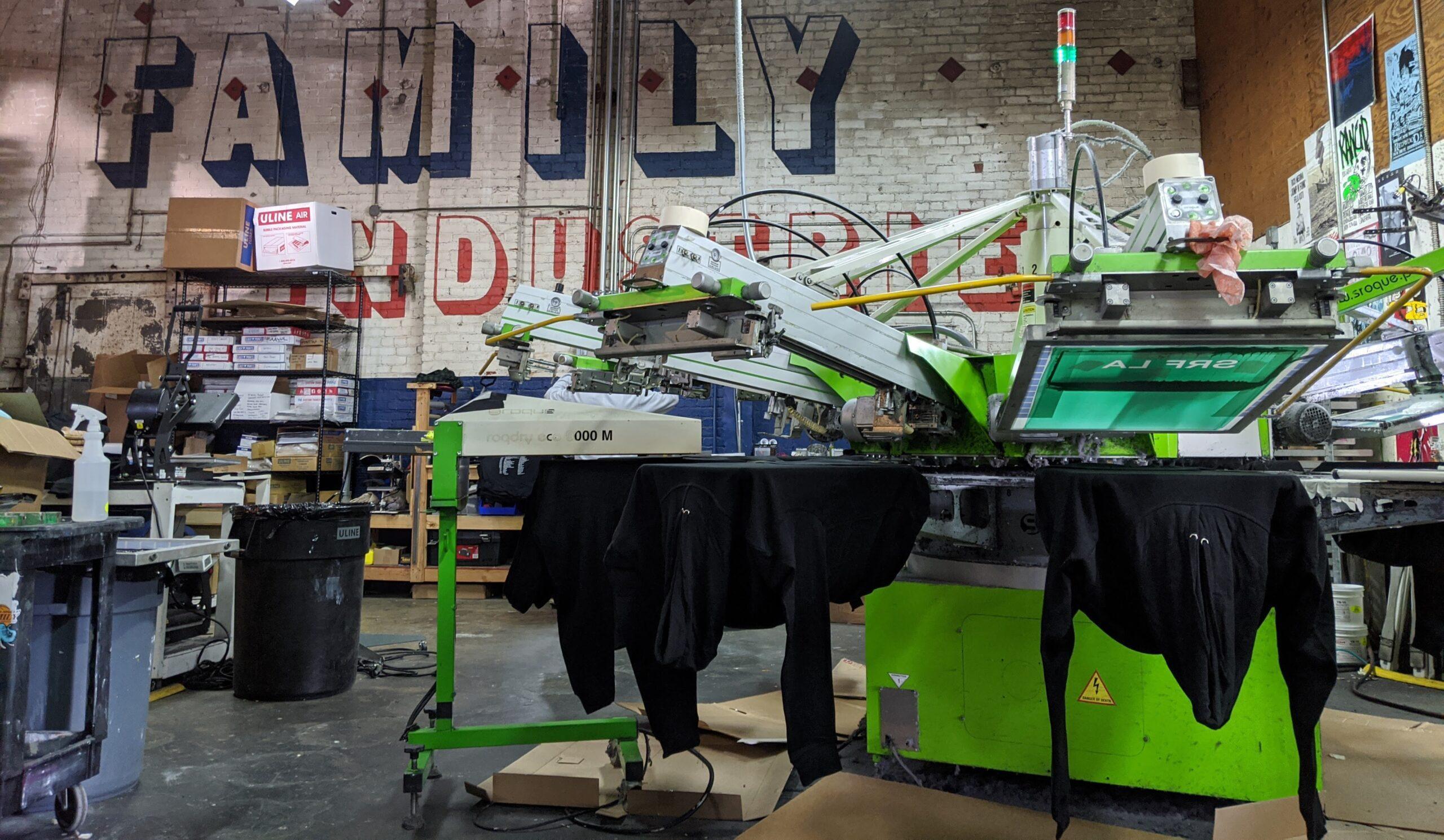
When you’re growing a print shop, revenue can climb while margins shrink, production becomes harder to manage, and the owner spends more time putting out fires. As lots of owners will tell you, bigger isn’t always better.
Sustainable growth means winning the right work, pricing it correctly, moving it through production consistently, and building a business that supports the goals you have for yourself and your team.
Sometimes that means adding equipment, space, and people. At other points, it might mean simplifying things and scaling back.
Here are seven practical areas to review as you build a stronger, more profitable print shop.
1. Review your pricing before rising costs force your hand
Blank apparel, transfers, ink, wages, rent, shipping, utilities, software, and payment-processing fees rarely stay fixed for long.
If your pricing doesn’t adapt to fluctuating costs, your margins can erode quietly.
Create a recurring pricing rhythm for your shop:
- Review high-volume products and services quarterly.
- Conduct a complete pricing review at least once a year.
- Recalculate setup, artwork, rush, delivery, and minimum-order fees.
- Compare estimated labor and material costs with what completed jobs actually consumed.
- Identify customers or order types that aren’t worth the time, anything that is high effort with low reward, like constant rush orders, one-offs, or excessive revisions.
With this approach, you can adjust quantity breaks, raise minimums, separate artwork or rush fees, or discontinue a service that consistently underperforms, rather than constantly raising prices across the board.
This strategy also prices your work so you can deliver a great product, pay your team, reinvest in the business, and remain profitable.
For a deeper look at the numbers, read Printavo’s guide to screen printing pricing and contribution margin.
2. Let your own order data guide your strategy
Industry benchmarks can be interesting, but your shop’s data should drive your decisions.
A single average order value can hide major differences between a profitable repeat program and a complicated one-time job that ties up production for days.
Review your completed orders by service, customer type, quantity, turnaround time, sales channel, and production method. Then ask:
- Which jobs generate the most contribution margin per production hour?
- Which customers reorder consistently and approve work quickly?
- Which order sizes best fit your current equipment and staffing?
- Where do estimates miss the actual labor, spoilage, or outsourced costs?
- Which jobs create the most schedule changes and production bottlenecks?
This analysis gives you a practical definition of your ideal job.
This way, you can prioritize the work that fits your capabilities, available capacity, and profit goals. You can also identify areas where better pricing, clearer customer expectations, or a more consistent workflow would turn an average job into a strong one.
3. Build around a niche you can serve exceptionally well
Newer shops often accept almost any job to generate cash flow, learn the market, and build customer relationships. Over time, you’ll find niches that work best for you.
Certain customers are easier to win, easier to serve, more likely to reorder, and more profitable.
A strong niche usually combines:
- Repeat demand
- A clear need your shop can meet
- Production requirements your team handles well
- Healthy margins
- Referral potential
- Opportunities to sell beyond your immediate geographic area
Once you identify that fit, build around it.
Create niche-specific offers and landing pages. Collect testimonials and customer stories. Provide examples that demonstrate your understanding of the buyer’s industry. Develop outreach that speaks directly to their timelines, budgets, events, uniform needs, fundraising goals, or approval process.
For example, a shop focused on construction and trades could build an offer around durable uniforms, employee onboarding kits, safety apparel, easy reorders, and job-site delivery. A shop serving schools could emphasize spiritwear, team stores, fundraising, seasonal ordering, and simplified payment collection.
See Sales Hacks: Know Your Niche for additional ideas on using testimonials, social proof, and targeted outreach.
4. Define your shop’s growth sweet spot
More revenue usually requires more management, space, equipment, inventory, working capital, and process.
Every growth stage adds cost before the next level of efficiency arrives. A new press may require another operator. A larger team may require dedicated production leadership. More departments can create additional handoffs, meetings, and administrative work.
That is why revenue alone is an incomplete goal.
Define success using a wider scorecard that includes:
- Owner compensation and weekly workload
- Operating margin
- On-time delivery
- Production utilization
- Work in progress
- Reprint and spoilage rates
- Customer concentration
- Employee retention
- Cash required to fund growth
Your shop’s sweet spot is the size and job mix where profitability, operational control, and owner quality of life are strongest.
For one owner, that may be a lean team running a few highly utilized pieces of equipment. For another, it may be a larger operation with specialized departments and a strong management team. Either can be successful when the structure is intentional.
Before taking on another lease, press, shift, service, or management layer, model the complete cost. Then determine how much additional profitable work will be required to support it.
5. Remove repetitive work before hiring
Hiring can solve a genuine capacity problem, but it can also make you inefficient.
Before expanding your crew, map the work and look for steps that can be removed, standardized, automated, or outsourced.
Start with a simple time study. Follow an order from the initial quote request through delivery. Record where it waits, changes hands, gets entered more than once, or depends on someone remembering what should happen next.
Look for opportunities to:
- Standardize quote, artwork, and production statuses
- Build templates for common products and customer types
- Automate routine approvals, reminders, and internal notifications
- Rearrange equipment or inventory to create linear paths
- Document recurring tasks and decision points
- Outsource specialized work beyond your scope
- Cross-train employees for critical tasks
See Printavo Automation for examples of repetitive shop workflows that can be automated.
6. Use AI as a drafting partner
AI can also speed up front-office work. It can help your team create first drafts of sales emails, social captions, marketing campaigns, job descriptions, process documentation, and customer FAQs.
Treat it as a drafting partner, not an autopilot. Every result should be reviewed for accuracy, brand voice, pricing, legal concerns, and customer promises.
Here are three evergreen prompts your team can adapt. Replace the bracketed fields before submitting them to the AI tool of your choice.
Email campaign prompt
Create a four-email campaign for [shop name] targeting [customer niche]. We provide [services] and help customers solve [specific problem]. Use a practical, friendly tone. Include one clear call to action and three subject-line options for each email.
Social content prompt
Create 10 social posts for [shop name] promoting [service, product, or campaign] to [target audience]. Include a mix of educational, behind-the-scenes, testimonial, and promotional content. Keep each post under [word count] and include a clear next step.
Process-improvement prompt
Review the following business process and identify repeated steps, bottlenecks, unclear handoffs, and tasks that could be standardized or automated. Return the recommendations in priority order and explain the expected benefit of each change: [paste the process].
The more context you provide, the more useful the result will be. Include your audience, services, differentiators, preferred tone, offer, proof points, and desired action.
7. Track contribution margin, not just revenue
Print-shop pricing can become complicated because owners try to account for every possible variable at once.
Contribution margin gives the team a simpler way to understand what each job contributes to the business.
Contribution margin = job revenue − variable costs
Variable costs change when you produce another job. Depending on how your business accounts for expenses, these may include:
- Blank garments
- Transfers
- Outsourced decoration
- Job-specific shipping
- Sales commissions
- Payment-processing fees
Fixed operating costs are expenses the shop incurs regardless of whether an additional order is placed. These may include rent, insurance, software, and salaried administrative roles.
Some expenses, such as labor and utilities, may be treated differently depending on your business model. The important thing is to classify costs consistently and review the approach with your accountant.
Consider a simple example:
- Job revenue: $2,000
- Variable costs: $800
- Contribution margin: $1,200
- Contribution-margin percentage: 60%
That $1,200 helps cover the shop’s monthly fixed operating costs. Once the combined contribution margin from all jobs covers those costs, additional contribution begins to generate operating profit.
Track both contribution-margin dollars and contribution-margin percentage.
A large job may produce strong contribution dollars but a weak percentage. A smaller repeat order may be attractive because it moves through production quickly, requires little administrative work, and uses otherwise available capacity.
Contribution margin per production hour can be especially useful when the shop is busy. It helps identify which work best uses a limited schedule.
Review contribution margin by:
- Customer
- Service
- Order size
- Production method
- Sales channel
- Sales representative
Build the print shop you actually want
The best growth plan is more of the right work, priced accurately, moving through a system of repeatable processes.
It is a business that protects its margin, adapts to changing costs, uses technology intentionally, and gives the owner greater control.
Start by taking one action in each area:
- Schedule your next pricing review.
- Define your most profitable job profile.
- Choose one customer niche to prioritize.
- Document your shop’s growth sweet spot.
- Automate one repetitive workflow.
- Begin tracking contribution margin consistently.
FAQ: Scaling a Print Shop
How do you scale a print shop?
Start by strengthening the systems behind the work you already have. Review your pricing, identify your best-fit customers and orders, standardize production workflows, remove repetitive administrative work, and track capacity and contribution margin. Add employees, equipment, or space only when sustained demand and realistic utilization justify the additional fixed cost.
What metrics should a growing print shop track?
Track average order value, contribution-margin dollars, contribution-margin percentage, contribution margin per production hour, quote-conversion rate, on-time delivery, reprint and spoilage rates, work in progress, equipment utilization, and repeat-order rate. Together, these metrics show whether growth is strengthening the operation or simply increasing its workload.
How often should a print shop review its pricing?
Review high-volume garments, services, and fees quarterly. Conduct a complete pricing review at least once a year. Pricing should also be reviewed whenever blank apparel, transfers, labor, shipping, utilities, payment processing, or other meaningful costs change.
When should I hire another employee?
When a persistent workload or production bottleneck remains after the shop has improved its processes, clarified responsibilities, and removed unnecessary work. Before hiring, document the tasks you’re hiring for and the additional contribution margin needed to cover wages, taxes, benefits, training, and management time.
When should a print shop invest in new equipment?
When demand is consistent, current capacity is genuinely constrained, and the equipment is expected to remain productively utilized. Include financing, labor, training, consumables, maintenance, downtime, facility changes, and working capital in the decision. The purchase should solve a measurable operational problem rather than simply add another capability.
What is contribution margin in a print shop?
Contribution margin is the revenue from a job minus the variable costs required to produce that job. It shows how much the order contributes toward fixed operating costs and, after those costs are covered, operating earnings. Shops can use contribution margin to compare customers, services, production methods, order sizes, and the value of jobs competing for limited production time.
What makes a good niche for a print shop?
A strong niche has repeat demand, a clear customer need, healthy margins, referral potential, and production requirements that fit the shop’s capabilities. Rather than choosing a niche based only on market trends, analyze completed orders to determine which customer types reorder consistently, approve work efficiently, fit the schedule, and generate the strongest contribution per production hour.
How can print shop management software support growth?
Print shop management software can bring together quotes, approvals, payments, scheduling, production statuses, reporting, and customer communication into a single shared workflow.
This reduces duplicate entries, improves visibility across departments, and makes bottlenecks easier to identify. Printavo currently supports those functions within its shop-management platform.
Ready to rethink your workflow? Try Printavo for free.

0 Comments