A screen printing quote template is a standard layout your shop uses for every quote: customer and contact, garments with colors and size breakdown, decoration details for each print location, unit and total prices, what the price includes, assumptions, turnaround, an expiration date and a clear way to approve. A consistent template makes quotes faster to build, easier for customers to compare, and harder to misread. It also makes the next step obvious, which matters because many quotes are lost to silence, not to price.
This guide lists the fields a quote needs, shows how to present options and assumptions, sets an expiration and follow-up plan, and explains how an approved quote becomes a production-ready order. Printavo is built for apparel decorators: screen printers, embroiderers, and DTG and DTF shops.
Qualify before quoting
Confirm the purpose, quantity, audience, budget, required date, garment preferences, and artwork. Identify the decision maker and any purchasing requirements. If essential details are missing, explain the assumptions or arrange a conversation rather than presenting an uncertain price as final.
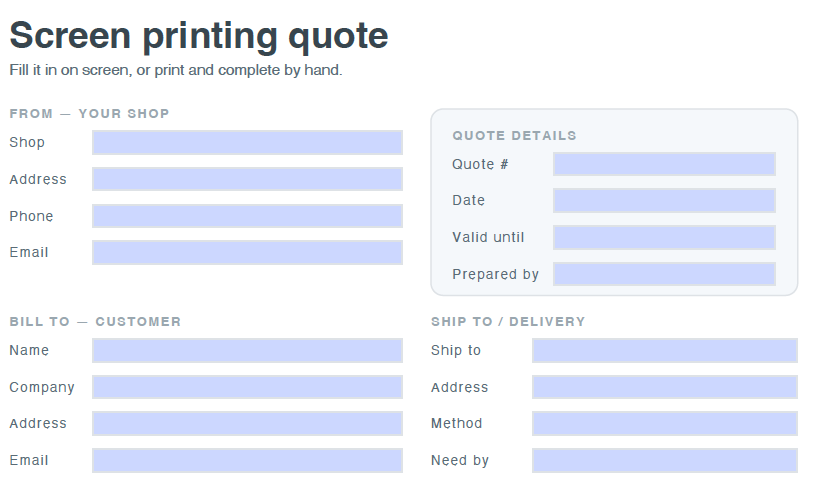
Here’s a quick snapshot of what your quote template should look like. Grab a free copy here.
Should you quote every request?
Quote the requests you can win and produce well. Before you price, confirm five things: the in-hands date, an approximate quantity, the garment type, whether artwork exists, and who approves and pays. A request missing two or more of these is a conversation, not a quote. Ask first, then price.
What should a screen printing quote include?
| Field | Why it matters |
|---|---|
| Customer, contact and who approves | The right person gets the quote and the approval request |
| Garment brand, style, color and size breakdown | Prevents ordering the wrong blanks; upsizes are often priced differently |
| Decoration per location: method, size, ink colors | Defines what you will print and what the price covers |
| Unit price, quantity breaks and total | Lets the customer compare options without asking |
| Setup, screen, art and rush charges | Stops “extra charges” disputes later |
| Assumptions | States what the price depends on (art supplied print-ready, garment availability) |
| Turnaround and in-hands date | Ties the promise to approval and payment dates |
| Mockup | Shows what the customer is approving |
| Expiration date | Protects you when garment or freight costs change |
| Deposit and payment terms | Sets cash expectations before production |
| How to approve | One clear action: approve online, sign or reply |
How should you present options and assumptions?
Offer two or three clear options instead of one take-it-or-leave-it price. Change one variable at a time so the difference is easy to see.
| Option | Garment | Illustrative price per piece | |
|---|---|---|---|
| Good | Standard cotton tee | 1 color front | $9.50 |
| Better | Ring-spun cotton tee | 2 colors front | $12.75 |
| Best | Ring-spun cotton tee | 2 colors front, 1 color back | $15.25 |
Prices are examples only. Build yours from your own costs with the screen printing pricing guide. Write assumptions in plain language, such as “Price assumes print-ready vector art. Art cleanup is $40 per hour if needed.”
Make options understandable
When offering alternatives, show what changes between them. A lower-priced option might use a different garment, simpler decoration, or a different delivery arrangement. Avoid a list of prices without enough context for the customer to choose.
How long should a quote stay valid?
Many apparel shops set quotes to expire in 14 to 30 days, because blank garment prices, stock levels and freight change. Put the expiration date on the quote and repeat it in follow-ups. When a quote expires, recheck garment cost and availability before honoring it.
How should you follow up on a quote?
Assign every quote one owner and a follow-up schedule. A simple cadence:
| Day | Follow-up |
|---|---|
| 0 | Send the quote with the mockup and the approval link |
| 2 | Confirm it arrived and answer questions |
| 5 | Offer an option change if price or timing is the blocker |
| 10 | Remind them of the in-hands date and the order deadline it requires |
| 14 | Final note before expiration; mark won or lost with a reason |
Track your win rate so you know whether follow-up is working:
Quote win rate = quotes approved ÷ quotes sent
Expected revenue = open quote value × win rate
Illustrative example: 40 open quotes worth $48,000 at a 30% win rate point to about $14,400 in orders. Raising the win rate to 35% with consistent follow-up adds about $2,400 without a single new lead. For a fuller cadence, see the five-touch sales follow-up plan.
What happens after the quote is approved?
An approved quote should become a production-ready order without retyping. Before it moves to production, confirm:
- Quote approved and recorded, with the approver’s name and date.
- Artwork approved separately, with the approved version recorded on the order.
- Deposit received if your terms require one.
- Garments ordered, with the expected arrival date.
- Due dates set: the customer’s in-hands date and the production date.
A real shop workflow: from request to order
A high school booster club emails for 150 tees for a fall fundraiser. The shop’s front office qualifies the request in one call, then builds a quote with a good and a better option, a mockup, an assumption about print-ready art and a 21-day expiration. The quote goes out with an approval link. On day 5, the club asks for a cheaper garment, so the rep revises the good option. The club approves on day 7, the deposit request goes out with the approval, and the order moves to “Garments ordered” the same afternoon.
How Printavo handles quoting
Printavo is production-first shop management software for apparel decorators that connects quoting, approvals, scheduling, invoicing, and payments.
- Pricing matrices and customer pricing tiers price decoration the same way on every quote. See Printavo order management and quoting.
- Supplier catalogs bring current product data and imagery into quotes, and mockups can be attached so the customer sees what they approve.
- Approvals: quote and artwork approvals can be requested separately and are recorded on the order.
- Automations send approval requests and reminders by email or SMS: 5 on Lite, 15 on Standard and 30 on Premium.
- The approved quote becomes the invoice, and a payment request can collect the deposit.
- Plan note: Lite includes 20 quotes and invoices per month; Standard and Premium are unlimited.
FAQ
What is the difference between a quote and an invoice? A quote is a priced offer the customer approves. An invoice requests payment for the approved order. In Printavo, the approved quote becomes the invoice, so prices are not re-entered.
Should I put prices on my website instead of quoting? Published prices work for simple, repeat orders. Custom jobs with several variables are usually better quoted.
How fast should I send a quote? As fast as you can send an accurate one. A same-day quote with a mockup tends to beat a cheaper quote that arrives days later [general practice].
What should I do when a customer goes quiet? Follow the cadence, offer an alternative option, and close the quote as lost with a reason when it expires.
Related guides
- Print shop job tracking: build statuses your team can trust
- Accounts receivable for print shops
- How to protect your shop from buyer fraud
- Printavo pricing
Send quotes customers can approve in one click. Try Printavo free for 7 days. No credit card required.